In car audio, MOSFET means metal-oxide-semiconductor field-effect transistor. It is a fast, voltage-controlled power transistor used to switch and regulate current inside an amplifier. The term most often refers to the transistors in the amplifier’s DC-DC power supply, although many designs also use MOSFETs in the audio output stage.
That definition matters because a vehicle supplies roughly 12 to 14.4 V, while a high-power amplifier often needs higher positive and negative supply rails to deliver clean voltage swing to a speaker. MOSFETs make that conversion practical by switching battery current rapidly through a transformer. If you want the full device-name breakdown first, see what MOSFET stands for.
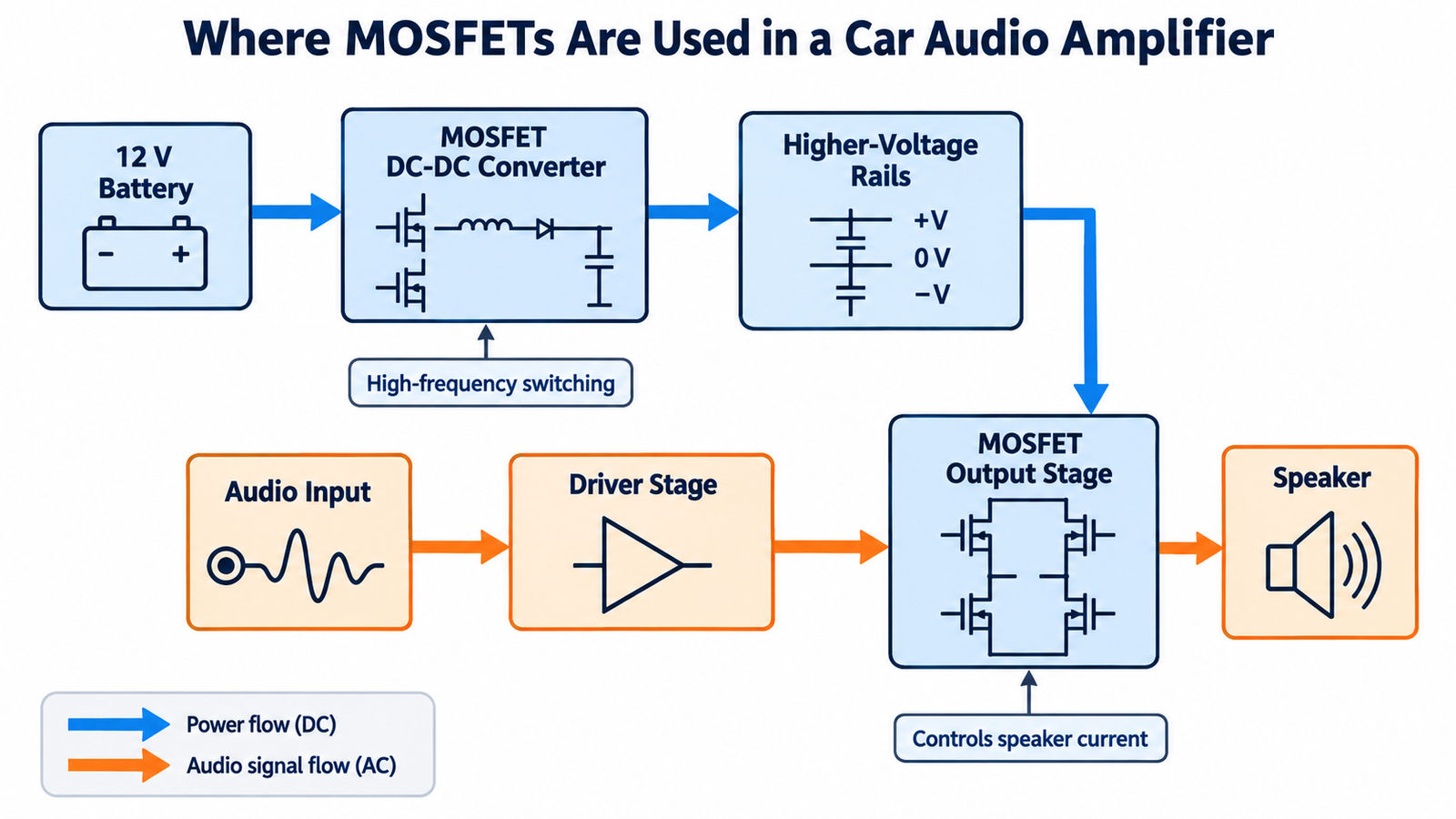
Where are MOSFETs used in a car amplifier?
1. The DC-DC power supply
The amplifier first converts battery power into the internal rails required by its output circuit. A controller drives several MOSFETs on and off at high frequency. Their pulsed current energizes a transformer, and rectifiers plus capacitors produce the higher DC rails. This section is a compact switching power supply adapted for an automotive electrical system.
The MOSFETs must handle high input current, repetitive switching, battery transients, and elevated temperatures. Low on-resistance reduces conduction loss. Appropriate gate charge, a capable driver, short current loops, and low-inductance wiring reduce switching loss and voltage overshoot.
2. The audio output stage
Some Class AB amplifiers use MOSFETs as analog output devices. They operate over a continuous portion of the audio waveform and dissipate significant heat. In a Class D amplifier, output MOSFETs switch rapidly to create a pulse-width-modulated signal. An output filter and the speaker’s impedance recover the audio-frequency current.
Class D does not mean the audio is simply turned fully on and off. The switching duty cycle contains the instantaneous audio information. With a well-designed driver, dead time, feedback loop, and filter, the amplifier can be efficient and accurate. The site’s audio amplifier application page shows where power semiconductors fit in the wider signal chain.
Does MOSFET mean the amplifier is better?
Not by itself. “MOSFET power supply” became a useful product description because MOSFETs replaced slower or less convenient switching devices in many designs. Today, MOSFETs are normal in modern car amplifiers. The word identifies a component technology, not a complete quality grade.
Judge an amplifier with measurable system specifications:
- Continuous RMS power: compare power at the same supply voltage, load impedance, frequency range, and distortion limit.
- Load stability: confirm that the amplifier supports the wired speaker impedance, including bridged operation.
- Efficiency and idle draw: these affect battery demand, alternator loading, and heat.
- Signal performance: review signal-to-noise ratio, total harmonic distortion plus noise, frequency response, and channel separation.
- Protection: look for overtemperature, overcurrent, short-circuit, undervoltage, and DC-output protection.
- Thermal construction: inspect the heatsink, airflow path, device mounting, and thermal interface.
Why car audio MOSFETs get hot
A low-resistance switch is not a zero-resistance switch. When a MOSFET is on, its approximate conduction loss is proportional to current squared times RDS(on). During each transition, drain voltage and current overlap and create switching loss. Gate-drive loss, body-diode conduction, transformer loss, rectifier loss, and copper resistance add more heat around the device.
Temperature also raises the on-resistance of a silicon MOSFET, so a design must use the hot RDS(on), not only the room-temperature headline value. The principles in this guide to designing the PCB thermal path for power MOSFETs apply directly to compact amplifier layouts.
What the MOSFET label does not tell you
It does not reveal the number of devices, their voltage margin, their safe operating area, or whether they are genuine and correctly mounted. It also does not indicate the amplifier class. A product can have a MOSFET power supply and a bipolar output stage, or MOSFETs in both sections.
Peak or “maximum” wattage is also not a substitute for continuous power. A reliable comparison uses the same test conditions and considers the vehicle’s real charging voltage and wiring drop.
Installation factors that affect MOSFET reliability
- Use adequate power and ground cable. Excess resistance lowers the supply voltage and can force higher current for the same output power.
- Fuse the battery connection correctly. The fuse protects the cable and vehicle in a fault.
- Provide ventilation. Do not bury a heatsink under carpet or against trim that blocks convection.
- Wire speakers within the rated impedance. Too little load impedance can push output devices beyond their current and thermal limits.
- Set gain correctly. Gain is input-sensitivity matching, not a volume control. Excess gain encourages clipping and extra heating.
- Keep connections tight. A poor ground can create voltage drop, noise, intermittent shutdown, or damaged terminals.
How designers select MOSFETs for car audio
For the power supply, selection starts with drain-source voltage margin for automotive transients, pulsed current, hot RDS(on), gate charge, switching energy, package thermal resistance, and avalanche behavior. The driver must supply enough peak current to charge and discharge the gates without excessive transition time. For the output stage, linearity or switching figures of merit depend on amplifier class.
The practical process is broader than choosing the lowest resistance. Our MOSFET selection and gate-drive guide explains how electrical, thermal, and layout decisions interact.
Frequently asked questions
Is a MOSFET car amplifier the same as a Class D amplifier?
No. MOSFET describes the transistor technology. Class D describes the output-stage operating method. Class AB and Class D amplifiers can both use MOSFETs.
Can a MOSFET improve sound quality?
A suitable MOSFET can help a designer build an efficient, stable amplifier, but sound quality depends on the complete circuit, feedback, biasing, layout, power supply, filtering, and protection. The device name alone is not evidence of lower distortion.
Why does my amplifier enter protect mode?
Common causes include low supply voltage, a shorted speaker wire, an unsupported impedance, overheating, DC at the output, or an internal power-device fault. Check installation conditions before replacing components.
Can I replace a failed MOSFET with any device that has the same package?
No. Match polarity, voltage rating, current capability, hot RDS(on), gate charge, threshold range, switching behavior, body-diode characteristics, pinout, and thermal performance. In parallel banks, technicians often replace matched devices and verify the gate-driver circuit as well.